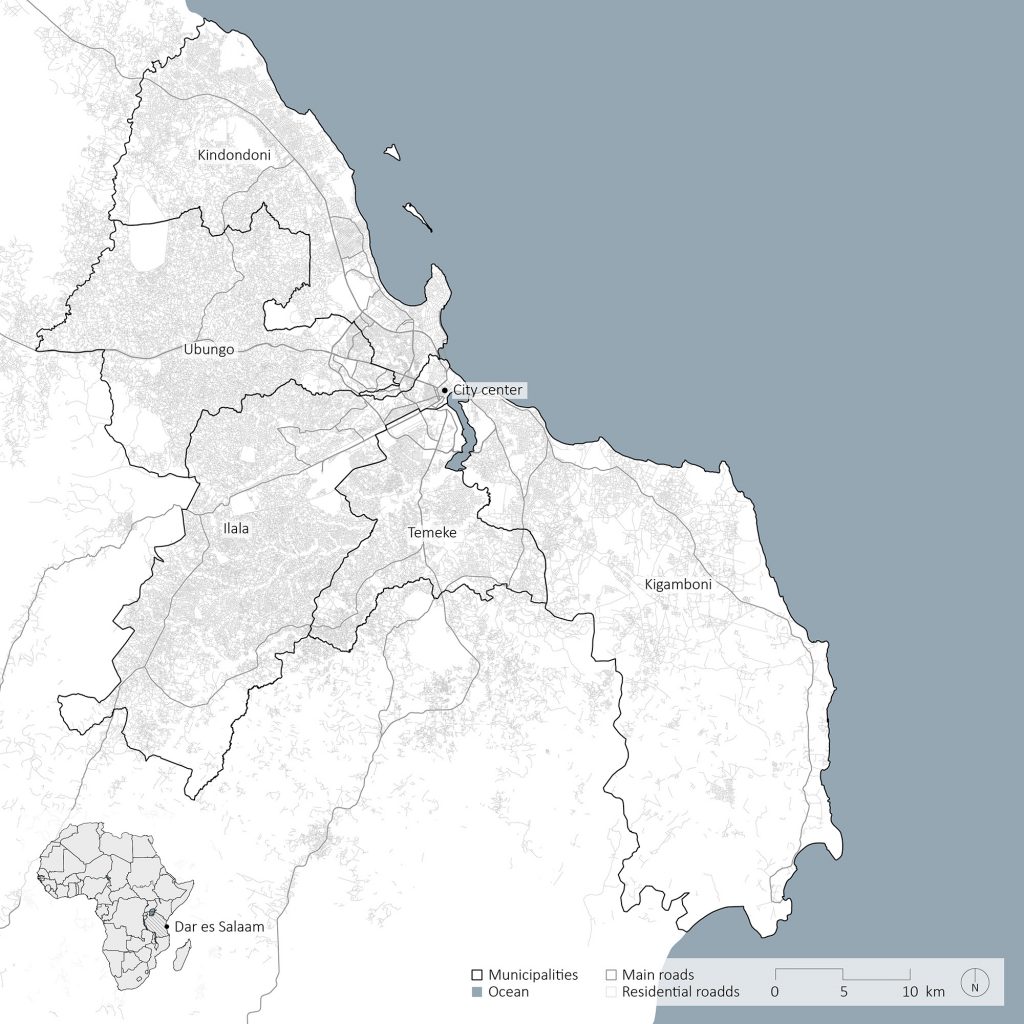
In 2008, the Tanzanian government announced plans to redevelop five wards in Kigamboni into a satellite city accommodating 500,000 residents, including a new central business district, educational institutions, and recreational areas. A development moratorium was imposed on the affected wards, and the Kigamboni New City Master Plan was approved in 2010. Developed primarily by Korean consultants, the plan adopted a largely top-down approach with limited consideration of existing settlements. The proposed eviction and resettlement of more than 80,000 residents generated widespread opposition, while the Kigamboni Development Agency (KDA), established to oversee implementation, faced resistance from local stakeholders. Following a change in government in 2015, the project was effectively suspended and formally abandoned in 2017, when the KDA was dissolved and planning authority transferred to the newly established Kigamboni Municipality.
Despite its abandonment, the New City project stimulated land transactions and planning activities, particularly in peri-urban areas, supported by the growing involvement of private surveying and planning companies. Subsequent development included public-private housing projects, government-led land subdivisions, and resident-initiated planning schemes aimed at securing land tenure. In 2019, the consortium I4ID, in collaboration with Kigamboni Municipality and local residents, initiated the Kigamboni Detailed Framework and Guideline 2019–2039. Adopting a participatory approach, the initiative sought to reduce unplanned development, improve access to formal land tenure for low-income residents, and promote urban planning that accommodates infrastructure, public spaces, and socioeconomic activities. I4ID concluded its involvement in 2020, transferring implementation responsibilities to the municipal planning authority.
I served as consultant for I4ID to conduct external monitoring and evaluation for project reporting during the final stages of the project.